Assessing Climate Change Messages in Political Cartoons
Lisa Loffredi
Course: Ontario Grade 9 De-streamed Geography (CGC1W):
Overview of the Lesson:
What do political cartoons reveal about the differing perspectives on climate change?
Media Literacy: Students will learn to critically analyze political cartoons to understand the different perspectives about current climate change issues. The primary objective is to teach students how to read the codes and conventions of political cartoons.
AI Literacy: The lesson will briefly introduce students to GenAI prompt engineering, enabling them to compare and reflect upon their own analyses in contrast to those of GenAI and to assess GenAI’s biases or limitations.
Resources:
Lesson Slide Deck of climate change cartoons
| Overall and Specific Expectations | A1. Geographic Inquiry:
• A1.3 apply critical-thinking skills to assess the credibility and biases of relevant sources from a wide variety of media forms, including print, online, and social media as well as content produced using current innovations and technologies, including artificial intelligence. A2. Developing Transferable Skills: • A2.3 apply the concepts of geographic thinking when analyzing current events involving geographic issues within Canada to enhance their understanding of these issues and their role as informed citizens. |
| B2. Interactions between the Natural Environment and Human Activities • B2.4 analyze environmental, economic, social, and/or political consequences for Canada of changes in some of the Earth’s physical processes, including the impact of climate change, and assess local and regional mitigation and adaptation strategies. | |
| Learning Goals
What concepts/skills will students be learning about? |
Students will learn about:
• Key themes and messages conveyed in climate change political cartoons. • How political cartoons use visual and textual elements to communicate a point of view. • Differing perspectives on climate-related issues. • Effective prompting of GenAI tools. |
| Success Criteria
How will you know they have learned it? |
By the end of this lesson, students will be able to:
• Identify key themes and messages conveyed in political cartoons related to climate change. • Assess the effectiveness of visual and textual elements in communicating various points of view. • Recognize bias and differing perspectives. • Relate political cartoons to real-world geographical and environmental concerns. • Detect misinformation in the news and social media. • Understand the Dos and Don’ts about effective GenAI prompt engineering. • Craft effective and clear GenAI prompts. |
| Teaching ABOUT Media | In this lesson, students will learn about:
• The role of political cartoons to convey political and social messages. • How political cartoons are primarily an opinion-oriented media form. • How to analyze political cartoon messages by examining visual elements (i.e. symbolism and exaggeration) and techniques. |
| • How to effectively prompt GenAI clearly and specifically to obtain relevant inquiry responses.
• How to assess biases and limitations in GenAI responses. |
|
| Teaching THROUGH Media | Using political cartoons and GenAI, students will learn:
• The varying political and social perspectives. • The current and pertinent climate change issues. • To compare arguments that support and oppose (i.e. Is climate change real or a hoax?) • To decipher the relationship between climate change and human behaviour. • To assess media sources’ credibility and biases. |
| Media Key Concepts | Concept #2: Media construct reality
• Political cartoons are representations of real climate change experiences and global decisions pertaining to the framing of climate change issues. o How do the codes and conventions used in political cartoons convince the audience that they represent consequential climate change issues? Concept #3: Audiences negotiate meaning • When engaging political cartoons, audiences construct meaning based on their understanding, experiences and own biases. o Which elements are used to engage/attract the audience (colour, visuals, word choice, etc.)? o What is my interpretation of the meaning? o Who might interpret it similarly/differently? Why? Concept #6: Media communicate political and social messages |
| • Political cartoons communicate within a sociopolitical context.
o What is the cartoon’s political point of view? o How might the cartoon influence its audience’s political point of view? Concept #7: Form and content are closely related in each medium. • Political cartoons visually draw attention to and influence their contents. Political cartoons are often meant to be satirical or ironic, and as such, much of the visual and textual elements used are exaggerated or symbolic. o How do the form and genre shape the content of the cartoon? o How do cartoons influence the characteristics of the form? Concept #8: Each medium has a unique aesthetic form • Compared to news articles, political cartoons have a simplistic and artistic form that follows certain codes and conventions. o What codes and conventions communicate the cartoon’s aesthetics? |
|
| How will technology be incorporated in the learning? | Students will use tablets/laptops to record their ideas and to do their research. Students will use GenAI. |
| Guiding Questions | 1. What do we know about climate change?
2. How do we know it? 3. What claims are there to support and refute the causes and consequences of climate change? |
| Opportunities for
Assessment |
What will be assessed? |
| Assessment for Learning – asking probing questions; activating prior knowledge questions by analyzing political cartoons together as a class; exit tickets.
Assessment as Learning – class feedback after sharing analysis of group’s climate change political cartoon. Assessment of Learning – students will create a political cartoon that presents a particular viewpoint. |
|
| Minds On
20 minutes |
How will I engage the learner?
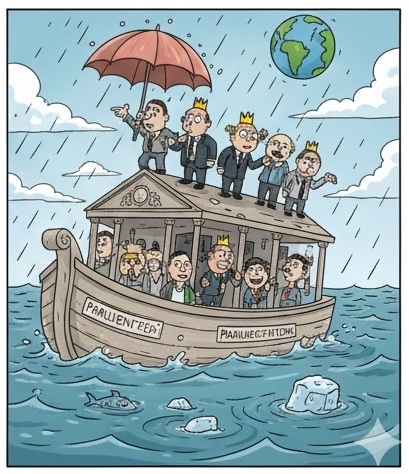
• Have the whole class list some current climate change issues. (i.e. wildfires, hurricanes, rising sea levels, extreme weather events, etc.) • Have the class identify who they would consider climate change supporters (e.g., scientists) vs. climate change deniers (e.g., politicians, certain industry leaders, etc.). Ask the class what motivates each group to believe or deny that climate change is real? • Begin with a large group discussion on the purpose of political cartoons: o What is a political cartoon? o How do cartoons use symbolism, exaggeration, and irony to communicate messages? o Why might climate change be a topic of political cartoons? • With the whole class, analyze an example of a climate change political cartoon. Assessment FOR Learning: During the minds on, students are prompted with questions, guided through an example, to activate their prior knowledge and assess their understanding of political cartoons. |
| Action
45 of minutes |
Human Literacy vs. AI Literacy
How does the lesson develop? • Group Analysis: Each group will receive a climate change political cartoon. Students will work in groups to analyze the political cartoon that will have groups: o Describing the visuals. o Identifying the issue portrayed. o Interpreting the message. o Analyzing the techniques used to produce the cartoon. • AI Analysis: After each group has finished analyzing their political cartoon, direct students to use AI to see what information it can generate related to their group’s political cartoon message. This will allow students to see whether AI is able to accurately interpret the codes and conventions of political cartoons. o Students will upload the political cartoon into GenAI with a detailed description of the political cartoon. o Students will prompt GenAI to analyze the message and perspectives portrayed. Students will record the exact prompt. o Students will record AI’s analysis of the cartoon. |
| • Comparison and Reflection:
o Using their group’s worksheets, students will compare their own group’s analysis of the political cartoon with GenAI’s analysis. ▪ In what ways is your analysis similar to the GenAI’s analysis? ▪ In what ways is your analysis different from the GenAI’s analysis? ▪ Did the GenAI identify any aspects of the cartoon that you missed? ▪ Did you identify any nuances or subtleties that the GenAI missed? o Student groups will also evaluate the strengths and weaknesses of AI’s responses: ▪ What are the strengths of human analysis in interpreting political cartoons? ▪ What are the weaknesses of human analysis? ▪ What are the strengths of GenAI’s analysis in interpreting political cartoons? ▪ What are the weaknesses of GenAI’s analysis? • Whole Class Sharing: Students will share their group’s political cartoon analysis, what prompt(s) they used, and what GenAI generated information they received. The class is given an opportunity to discuss and provide feedback. • Whole Class Discussion: Engage the class in a discussion on the use and usefulness of GenAI using the following guiding questions: o How effectively did GenAI respond to your group’s prompt(s)? o How might your group’s prompt(s) be improved to achieve better answers? o Did the GenAI introduce bias or inaccuracies, and how did you recognize it? o Where might you look to verify the GenAI’s responses? (i.e. library databases) ▪ Teach students what makes a good GenAI prompt (specific, clear, guiding the GenAI toward useful response). ▪ Teach students about the limitations of GenAI (bias, misinformation, inability to form human-like responses) |
|
| • Reflection on the Role of GenAI: Lastly, each group will reflect on the role of GenAI in generating useful information, and record their reflection:
o Why or why not might GenAI be a useful tool for analyzing and understanding political cartoons? o How might GenAI be used to help people understand visual communication? o What ethical considerations might be related to using GenAI for this purpose? • Verifying AI Responses: Show students how to access some of the library databases so they can verify GenAI responses and further deepen their understanding of the messages conveyed. Assessment AS Learning: In sharing their group analysis of a climate change political cartoon, other students in the class provide feedback and suggestions and can discuss each group’s analysis. |
|
| Consolidate & Debrief 10 minutes | Creating Political Cartoons
What will learners do to demonstrate their learning? • Political Cartoon Assignment – Students will be tasked to now create their own political cartoon, by drawing it themselves or by using graphic design software. • Along with the creation of the political cartoon, students will provide an oral or written explanation of their cartoon-related design choices. In their explanation, students will answer: o How did your design choices construct the message (define it)? o Who is your political cartoon meant for? Who is not meant for? (The audience) o How does your intended message relate to the issue? |
| • Exit Ticket – Reflection Questions
o What is ONE thing you learned today o How did today’s lesson make you FEEL? o What is ONE question you still have at the end of today’s lesson. Assessment OF Learning: Teachers will research and curate political cartoon exemplars |
|
| Personal Reflection | In drafting my lesson plan, I struggled in my understanding of ‘through’ and ‘about’ media and how to incorporate both into my lesson. My initial intention was to draft a lesson that incorporated teaching students how to navigate GenAI, as the geography teacher I collaborated with was interested in such a lesson. However, the challenge I faced was finding an effective way to incorporate GenAI into a lesson on climate change that could be essentially covered in only 1 lesson since I would be seeing the class only once. That’s when Michelle Solomon’s suggestion to have students use GenAI to interpret climate change cartoons and compare GenAI’s analyses with their own human analyses first would allow students to learn how to assess the strengths and weaknesses of GenAI’s results.
Going forward, it would be a good idea to look at the ethical implications of using GenAI and having it interpret others’ work. Neil Andersen suggested that it would be a good idea to have the students state their own climate change positions before the activity so that they might establish their own biases. It was an assumption on my part that students understand what it meant by satirical or irony in relation to political cartoons. Perhaps some time could be spent at the start of the lesson exploring these key concepts for further scaffolding of understanding. Lastly, if time permitted, students could test different prompts with GenAI to see which prompts gave better responses to their inquiries. |