Carol Arcus: Notes and Musings on IMLRS, Rome 2026

Carol Arcus: Notes and Musings on IMLRS 2026, Rome, Italy
Introduction:
As you might have predicted, this International Media Literacy Research Symposium in Rome tended to focus on AI. Many presenters moved beyond asking what AI could do for us and instead focused on what it is doing to us—to our learning, our relationships with media, and the kinds of people and communities we are becoming. But, while each speaker approached these questions from a different perspective, there was a common thread: AI is not simply another classroom tool (though potentially valuable) – it is reshaping how we think, create, communicate, and learn.
I chose to focus on a handful of experiences that were personal highlights over the 3 days. Alice Lee’s award; Msgr. Paul Tighe’s keynote that challenged us to think about AI in terms of human flourishing rather than technological progress; Donna Chu’s reminder that AI literacy is not emerging from nowhere, but builds on decades of work in media literacy and digital literacy; Michael Dezuanni raising important questions about representation, digital making, and agency. And in contrast, the School News Project from Australia providing a refreshing contrast by showing the continuing power of production-based media literacy work: students confidently and authentically creating news on paper for real audiences.
Taken together, these sessions left me thinking less about AI itself and more about the role of media literacy at this moment. The enduring questions still seem to matter: Who benefits? Who is left out? What values are being built into these systems? And perhaps most importantly, what kinds of learning—and what kinds of learners—do we want to encourage as AI becomes part of everyday life?
What emerged for me, in the end, was the warmth and cohesion of the global media literacy community itself. Whether participants came as activists, academics, or classroom educators working on the ground, there was a strong sense of shared purpose and mutual respect. The chance to make new friendships and collegial connections was the conference’s true gift.
Here are my idiosyncratic choices and ruminations:
*

Alice Lee
And the Jessie McCanse award goes to …
This award honors individuals whose contributions exemplify Jessie’s positive philosophy, her principles of fairness and ethical practices, her creativity, and her role as a collaborative bridge builder.
This year, the award was presented jointly to a longtime AML colleague, Alice Lee of Hong Kong Baptist University, and Thomas Bauer, University of Vienna. I will reflect on Alice’s response here.
It was a genuine pleasure to see and hear Alice Lee receive this award. In accepting it, she immediately spoke warmly about our founder, Barry Duncan, and AML, saying that she owed so much of what she knows to our influence. She recalled the impact of early conversations with John Pungente, Barry Duncan, and our President Neil Andersen, as well as the importance of Marshall McLuhan’s ideas—especially the notion of media environments—in shaping her thinking and, ultimately, her own work teaching critical thinking about AI. Congratulations to Alice, well-deserved!
Keynote: The Church and Communication in the Digital World (Msgr. Paul Tighe, Sr. Rose Pacatte, & Msgr. Paolo Ruffini)
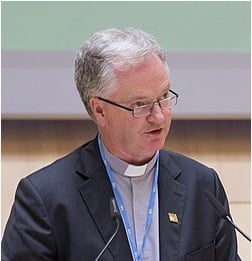
Msgr. Paul Tighe
Response:
This session explored how the Catholic Church can respond to a digital world shaped by social media, algorithms, and artificial intelligence, which are changing how people find information, form communities, and understand truth. It asked how the Church can engage these spaces ethically and effectively while addressing challenges such as misinformation and algorithmic influence.
I chose to focus on the message of Paul Tighe. (From the program: Paul Tighe is an Irish priest and Vatican leader whose work has focused on digital culture, communications, and education. He has also helped shape the Church’s thinking on artificial intelligence, including the 2025 Vatican document Antiqua et Nova.)
Paul Tighe’s message could be read as a call for a critical media literacy approach to AI. He did not simply ask whether AI was powerful or useful, but what kind of media environment it was creating and what kind of human beings and communities it was shaping.
He consistently returned to familiar media literacy questions: Who has power? Who makes the decisions? Who is included, and who is marginalized? What values are embedded? His insistence that AI development had to be “dialogical,” involving everyone from the most powerful to the least powerful, positioned AI not as a neutral technology but as a social and cultural force whose design, ownership, and consequences deserved public scrutiny.
He urged listeners to “find out who makes decisions and how they are made”—essentially a call to action—and to investigate producers, institutions, and ideologies (It reminded me very much of the concepts and questions embedded in AML’s critical frameworks.)
AI, in this framing, was not simply a tool that appeared in the classroom or on a screen; it was a mediating structure shaped by corporate, political, economic, and cultural interests. He reminded us that there were “architects” and there were “victims” of AI. He encouraged us to look beyond celebratory narratives of innovation and ask who benefited, who was harmed, who was rendered invisible, and whose interests were being served. At the centre of this was a simple question: does AI empower the public, or does it further concentrate power in the hands of those who already have it?
Tighe also pushed us to think about representation, identity, and human dignity. He warned that it was easy to give away our identity and to place too much faith in the idea that technology would solve our problems. He also observed that AI could produce a simulation of empathy. This was not just a philosophical point; it was a media literacy issue because it asked us to examine how media and technologies create emotional effects, trust, and the appearance of understanding. If people begin to confuse simulated empathy with genuine human relationships, then AI is not merely assisting communication—it is reshaping the conditions under which empathy and human engagement are understood.
Another major thread was his concern with human flourishing and the social consequences of AI. He repeatedly asked what promotes the flourishing of communities, what supports peaceful cohabitation, and what keeps our attention focused on the marginalized. This shifted the conversation away from convenience or technical efficiency and toward broader social questions: Does AI deepen solidarity or intensify competition? Does it help us deliberate well, or does it fragment attention and weaken responsibility?
Perhaps the most important media literacy insight for me was Tighe’s characterization of AI as a mediating structure, deserving the same kind of critical attention that media literacy has long brought to television, advertising, film, news, and social media. His closing questions were: Is AI a servant, a co-researcher, an agent, or a tool? His warning was that, at a time when technological capacities are advancing rapidly and human beings may be “least ready,” we cannot afford to stumble forward blindly.
AI Imaginaries and AI Literacy: Valuable Lessons from Media Literacy Education. Donna Chu, Chinese University of Hong Kong (Hong Kong)
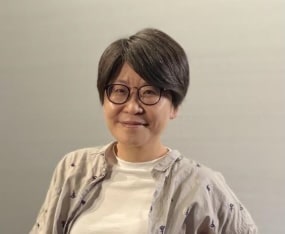
Donna Chu
Summary:
The paper argues that AI literacy may feel new, but schools have faced similar challenges before with film, television, digital media, and the internet. Its main point is that AI literacy should build on the long history of media and digital literacy, since the core task remains helping young people navigate a changing information environment critically and responsibly.
Response:
Donna Chu’s presentation, “AI Imaginaries and AI Literacy: Valuable Lessons from Media Literacy Education,” explored how the way we imagine AI shapes the educational response we build around it. One of her underlying ideas was that of imaginaries—we get what we imagine. If AI is framed as an inevitable disruption, a threat, or a powerful new agent, those assumptions will shape what we think AI literacy needs to be. She also noted that AI literacy is being framed in relation to media literacy and digital literacy, rather than treated as something entirely separate.
What has actually changed, and what has not was the key question running through the presentation. Chu situated AI as the latest “major disruption” in a longer history of media and technological change, but she also suggested that many educational concerns remain familiar. The issue of threats to children, for example, has not disappeared; AI is simply the newest expression of broader concerns about how young people encounter, use, and are shaped by media and technology. In that sense, her talk pointed back to media literacy education as an important source of insight.
The notion of awareness emerged prominently. AI literacy, in her framing, was not simply about learning to use new tools, but about understanding what kind of technology AI is, how it works in the world, and how it changes communication, learning, and knowledge production. At the same time, she argued that AI does require new skills because generative AI complicates the older idea of technology as a straightforward tool. AI can seem more agentic in the way it generates language, images, and responses, and this changes how we think about authorship, responsibility, and trust.
Another important thread was human–AI collaboration as co-creation. AI literacy, in this view, has to include not only critical analysis of media and technology, but also the practical and ethical skills involved in working with generative systems. Chu framed AI within a broader media ecology: understanding AI means understanding the whole environment of platforms, tools, systems, and risks. Her point was not simply that new technologies require new technical skills, but that they also bring ethical responsibilities and demand new forms of self-care.
There was also a broader discussion about future developments in AI, echoing David Buckingham’s recurring question from his new publication, The End of Information: ”Where is this going?” Related concerns were raised about how companies such as OpenAI may seek to profit from schools. I found myself wondering what kinds of learning might emerge as AI technologies become cheaper and more accessible while still being shaped by the need to make money. The discussion ended with a reflection on the growing intersection of economics and education as AI becomes a potential tool for learning.
I came away with these questions:
- If AI literacy is framed as an extension of media literacy, what genuinely new understandings does it require, and what can still be addressed through existing media literacy frameworks?
- How should media literacy educators respond to AI’s apparent “agency”? If generative AI no longer feels like a passive tool but something closer to a co-producer, how does that change the way we teach authorship, responsibility, and trust?
- How should media literacy respond to the commercialization of AI in education? If AI tools become cheaper and more embedded in schools, but remain driven by profit motives, what kinds of learning will they encourage—and whose interests will they ultimately serve?
A social-material and relational media literacy approach for responding to AI generated Synthetic media – Michael Dezuanni and Amanda Levido. Queensland University of Technology and Southern Cross University (AUSTRALIA)

Michael Dezuanni
Summary:
Michael Dezuanni’s “Building Blocks” model shows how more agentic forms of digital media literacy can develop through work with AI-generated media. Making media with GenAI is not just about entering prompts, but about negotiating with the tool—and with the wider social, cultural, political, and economic assumptions built into it.
Response:
Prof. Dezuanni’s presentation* focused on synthetic images produced through AI and the questions they raise for media literacy, representation, and digital making. He illustrated the discussion with several outputs generated from the same prompt asking AI to represent a farmer in the Australian outback. The results were often disappointing and at times unintentionally funny, relying heavily on familiar stereotypes: the rugged outback cowboy/farmer, invariably white-skinned (though ruggedly tanned), equipped with large-brimmed Aussie hats and bandanas. Compared with the American stereotype, there was a notable absence of guns, but the dependence on stock imagery and familiar iconography was just as strong. For Dezuanni, these distortions pointed not only to problems of representation, but also to the economic forces shaping generative AI.
The outback images became one of the most memorable parts of the session. Dezuanni suggested that the stereotypes reflected not simply bias or poor prompting, but the commercial logics and training conditions behind AI image generation.
He also connected these images to socio-material and relational media literacy frameworks, stressing that making is embodied and socio-materially located. He was interested in people’s relationship with media, and in what it means to take part in a digital making process with AI. The curated images of the Australian outback illustrated how AI can channel and constrain media production identities through its own assumptions and patterns. His questions were not only about what AI produces, but about what happens to the maker in the process: What does it mean to co-make synthetic media with AI? In what ways does AI have agency in that process? What does agency mean in digital making with AI? He also drew an important distinction between reliability and trust.
My takeaways:
- If AI has become part of the media-making process, what does this mean for our understanding of agency?
- If generative AI repeatedly falls back on familiar stereotypes, how should media literacy help students recognize and challenge the assumptions embedded in AI-generated media?
- If making with AI is always a negotiation between the user and the system, what new understandings or production practices should media literacy encourage?
*Ms Levido was unable to attend.
How Student-Led School Newspapers Can Drive Media Literacy: Cat Rodie and Meredith Heaney, The School News Project (AUSTRALIA)
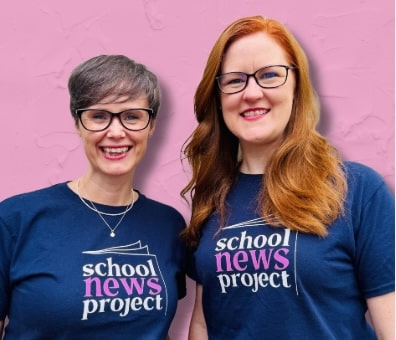
Cat Rodie and Meredith Heaney
Summary:
Student-led school newspapers can be an effective and engaging way to build media literacy in elementary school. In the Press Gang Program in New South Wales, Australia, students take on the role of reporters in a simulated newsroom, where they interview, fact-check, evaluate sources, write, and edit together before publishing a print or digital newspaper for their school community.
Report:
This was my personal favourite of all the presentations I attended, perhaps because it so clearly embodied the power of production-based media literacy education. The project began with an enthusiastic journalist parent and has evolved into a powerful example of authentic media literacy learning. Students were fully immersed in meaningful media production: the work was real, it mattered, and it had an audience. Over time, the project grew into a national Australian curriculum resource linked to core competencies.
The emphasis was on authentic learning. Students were not simply completing an assignment; they were making editorial decisions, deciding why a story deserved to be included, choosing topics that mattered to them, and thinking about audience throughout the process. They had to consider how to gather information, who the story was for, and how best to communicate it. Along the way, they learned practical media literacy lessons—such as the difference between a search engine and a source—while strengthening their communication skills. Because the learning was embedded in meaningful production, it also appeared to be more memorable.
The project also fostered a strong sense of student agency. Students had genuine choice and real responsibility, which seemed to translate into greater ownership of their learning. This was reflected in the project’s self-assessment data, where 74% of students reported an increased sense of agency.
My takeaways:
- If authentic media production gives students a stronger sense of agency, why isn’t production still at the centre of more media literacy programs?
- What would happen if we designed more classroom media projects with a real audience and a real purpose, rather than treating production as just another assignment?